
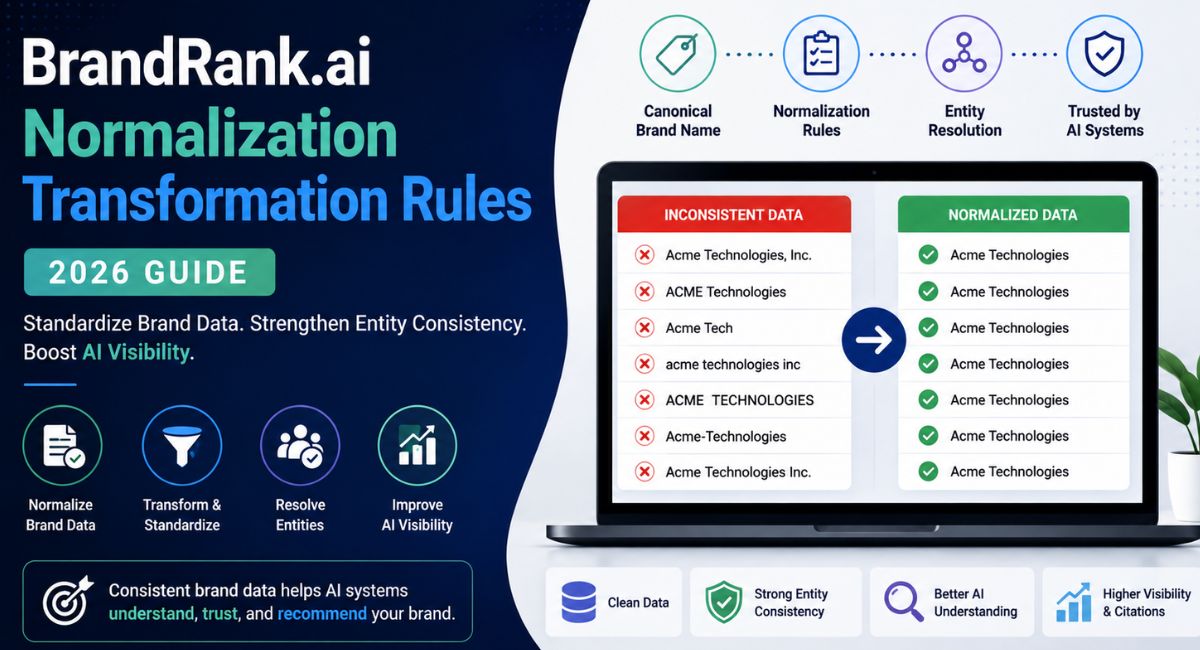
A single company can appear online as “Acme Inc.,” “Acme,” and “ACME Technologies,” creating confusing brand name variants. BrandRank.ai Normalization Transformation Rules help standardize these records for stronger brand data consistency and entity resolution. This guide explains practical normalization rules, canonical names, structured data, and AI visibility so your brand stays clearly identifiable.
What are BrandRank.ai normalization transformation rules?
BrandRank.ai normalization transformation rules describe a practical process for making brand information consistent across websites, directories, social profiles, and other digital sources. The main goal is stronger brand data consistency and clearer entity resolution.
In simple terms, normalization cleans inconsistent information, while transformation prepares that information for another system or format.
For example, these names may represent one company:
- Acme Technologies, Inc.
- ACME Technologies
- Acme Technology
- Acme Tech
People may understand the connection immediately, but automated systems need supporting signals to connect these records confidently.
Why do BrandRank.ai normalization transformation rules matter for AI visibility?
Consistent brand information can make it easier for AI systems and search engines to understand who a company is. AI visibility depends on many factors, but consistent entity information is an important part of a strong digital identity.
AI answer engines can encounter your business through your website, business listings, social profiles, publications, and other sources. Conflicting names, addresses, or categories create unnecessary ambiguity.
Recent entity-SEO research from Semrush also emphasizes consistent entity naming, structured data, and connections between a brand and its related entities. (Semrush)
Normalization does not guarantee AI citations. Relevance, authority, content quality, source reliability, and the specific user query also influence what an AI system recommends or cites.
What is the difference between normalization, transformation, and deduplication?
Normalization standardizes information, transformation changes its structure, and deduplication identifies records that may represent the same entity.
| Process | Purpose | Example |
| Normalization | Standardize values | “ACME, INC.” → “Acme” |
| Transformation | Change data format | Convert address fields into a standard structure |
| Deduplication | Find duplicate records | Identify two profiles for one company |
| Entity resolution | Confirm identity | Connect “Acme Tech” to the correct organization |
These processes often work together, but they should not be treated as identical.
How do BrandRank.ai normalization rules standardize brand names?
Brand name normalization starts with one defined canonical brand name and a documented set of legitimate variations. The aim is to remove accidental differences without damaging meaningful brand identity.
A practical process includes:
- Identify the official brand name.
- Record legitimate aliases.
- Separate legal and public-facing names.
- Define capitalization and punctuation rules.
- Document intentional exceptions.
- Test the rules against real records.
- Review uncertain matches manually.
This is safer than applying one aggressive rule to every record.
How should legal suffixes, capitalization, punctuation, and whitespace be handled?
Legal suffixes, capitalization, punctuation, and whitespace should be standardized only when the change does not alter identity. Legal suffixes such as LLC and Inc. can be removed from a display-name field while remaining in the legal-name field.
For example:
Raw: ACME TECHNOLOGIES, INC.
Display name: Acme Technologies
Legal name: Acme Technologies, Inc.
Intentional styling should be preserved. A brand such as eBay should not automatically become “Ebay” simply because a default capitalization standardization rule says so.
How should legal names and operational brand names be separated?
Legal names and operational brand names should be stored separately. This supports entity consistency without forcing every public reference to use the registered legal name.
Useful fields include:
- Legal name
- Canonical brand name
- Former names
- Common aliases
- Parent company
- Website
- Business locations
This separation becomes especially important after mergers, acquisitions, or rebranding.
Which brand data fields should be normalized besides the brand name?
Brand data standardization should cover more than names. Important fields include addresses, phone numbers, URLs, categories, social profiles, products, and locations.
Prioritize information that appears repeatedly across important sources:
- Business name
- Address
- Phone number
- Website
- Business category
- Social profiles
- Product names
- Location information
- Organization identifiers
For businesses with multiple locations, consistent information becomes even more important because the same organization may have many public records.
Use a consistent internal format while respecting the requirements of each platform. Address normalization should preserve accurate location information rather than simply making every address look identical.
can represent the same location.
Categories should use terminology customers understand. URLs should point to the correct pages, while social profiles should be checked for outdated usernames, duplicate accounts, and incorrect links.
How should you choose a canonical brand name?
Choose the canonical brand name from authoritative first-party information and established public usage. Do not simply choose the version that appears most often in a database.
Check:
- Official website
- Current branding
- Corporate information
- Major business profiles
- Reputable publications
- Existing structured data
Keep historical names and legitimate aliases separately. This lets your brand entity optimization process recognize older references without confusing them with the current identity.
How should you sequence BrandRank.ai normalization transformation rules?
The order of normalization rules matters because one transformation can affect another. Start with identity and source preservation before applying formatting changes.
A practical sequence is:
- Preserve the raw record.
- Identify the organization.
- Determine legal and brand names.
- Apply approved exceptions.
- Normalize capitalization and whitespace.
- Standardize punctuation.
- Normalize addresses and contact details.
- Validate URLs.
- Identify possible duplicates.
- Review uncertain matches.
- Publish the transformed record.
This sequence reduces the risk of changing information before understanding what it represents.
How can you handle brand-name exceptions and ambiguous matches?
Create an exceptions list for names that intentionally break your standard rules. Brand name variants are not always errors, so automation should distinguish legitimate differences from accidental inconsistencies.
Your exception list can record:
- Approved spelling
- Reason for exception
- Affected products
- Supporting source
- Date reviewed
This is particularly useful for stylized brands, subsidiaries, product names, and historical identities.
When should fuzzy matching be used instead of exact normalization rules?
Use fuzzy matching to find possible matches, not to automatically confirm them. Similar text alone does not prove that two records represent the same business.
Check additional evidence such as:
- Website domain
- Address
- Phone number
- Social profiles
- Industry
- Corporate ownership
- Products or services
For example, two businesses called “Summit Digital” in different cities should not automatically be merged because their names are similar.
How can you preserve raw brand data while applying transformations?
Keep the original value beside every normalized value. This creates an audit trail and makes incorrect transformations easier to reverse.
A useful structure is:
| Field | Example |
| Raw value | ACME TECHNOLOGIES, INC. |
| Canonical value | Acme Technologies |
| Legal value | Acme Technologies, Inc. |
| Rule | Remove suffix + standardize case |
| Source | Official website |
| Review date | August 2026 |
This simple structure can prevent major data-quality problems later.
How can you validate normalized brand data before publishing it?
Validate both formatting and identity. A perfectly formatted record can still be wrong if it belongs to another organization.
Before publishing, check:
- Name accuracy
- Address accuracy
- URL accuracy
- Duplicate records
- Category consistency
- Exception handling
- Source reliability
- Structured-data accuracy
A useful improvement is to give each record an identity-confidence score. A record with perfect formatting but weak identity evidence should receive human review.
How can structured data and sameAs links strengthen brand entity consistency?
Structured data provides machine-readable information about an organization. The sameAs property can connect an organization’s website with URLs that clearly represent the same entity.
For example, appropriate references could include an official LinkedIn company profile or another authoritative business profile.
Semrush’s research on AI search trust signals also highlights Organization schema, sameAs links, and consistent brand information across online profiles as useful entity signals. (Semrush)
However, do not add unrelated URLs simply to create more connections. An incorrect sameAs schema relationship can create confusion.
How can you measure whether normalization improves AI visibility and citations?
Measure data consistency separately from AI citation performance. A cleaner dataset is valuable even if citation frequency does not immediately change.
Track:
- Number of brand-name variants
- Conflicting addresses
- Duplicate listings
- Incorrect URLs
- Category inconsistencies
- AI brand mentions
- Accuracy of AI descriptions
- Relevant prompts where the brand appears
Run the same prompts periodically across major AI answer engines. Record dates and results so you can compare changes over time.
How often should BrandRank.ai normalization transformation rules be reviewed?
Review important brand information at least quarterly, with additional checks after major business changes. Transformation rules should change when your identity, products, locations, or organizational structure changes.
A practical schedule is:
- Monthly: check important listings.
- Quarterly: review rules and exceptions.
- After rebranding: conduct a full identity audit.
- After acquisition: review names, domains, locations, and ownership.
This turns normalization into an ongoing data-quality process rather than a one-time cleanup.
Who should own and maintain a brand normalization process?
One person or team should own the process, even when several departments contribute. Marketing, SEO, web, data, and brand teams may each control different parts of the information.
The owner should manage:
- Naming standards
- Data sources
- Exceptions
- Approval processes
- Listing corrections
- Structured data
- Regular audits
For small businesses, one trained employee may be enough. Larger organizations need clearer governance.
What are the most common BrandRank.ai normalization mistakes to avoid?
The most common mistakes are over-normalizing names, deleting raw information, merging records without evidence, and treating every source as equally trustworthy.
Avoid:
- Removing every legal suffix automatically.
- Merging similar businesses without verification.
- Overwriting original data.
- Ignoring old names after a rebrand.
- Using inaccurate sameAs links.
- Trusting weak sources over authoritative ones.
- Measuring only AI citations.
A strong process combines brand data consistency, reliable sources, human review, and repeatable normalization rules.
Frequently Asked Questions
Is BrandRank.ai normalization transformation rules an official product name?
The phrase should not automatically be treated as an official product name. Unless BrandRank.ai specifically documents it as a named feature, it is safer to use it as a descriptive term for normalization and transformation work related to brand data.
Does brand normalization replace traditional SEO?
No. Brand normalization supports SEO and AI visibility but does not replace technical SEO, content quality, links, search intent optimization, or other established practices.
Can BrandRank.ai normalization transformation rules be fully automated?
Some tasks can be automated, including formatting, duplicate detection, and basic normalization rules. Ambiguous entity resolution, exceptions, and source evaluation still benefit from human review.
How long does brand data normalization take?
It depends on the size of the brand footprint. A small company with several profiles may complete an initial audit relatively quickly, while large enterprises with multiple locations and legacy records require ongoing maintenance.
Do small businesses need brand normalization?
Yes, when inconsistent information appears across important sources. Smaller businesses can often benefit because their digital footprint is easier to audit and correct.
What is the most important brand normalization rule to implement first?
Start by defining one accurate canonical brand name. Then audit important websites, business listings, social profiles, addresses, and categories for conflicting brand name variants.
Conclusion
BrandRank.ai normalization transformation rules are best understood as a practical framework for improving brand data consistency and entity clarity. The process connects brand name normalization, entity resolution, structured data, and business listing consistency.
The best starting point is simple: define the canonical identity, preserve raw data, document legitimate exceptions, audit important sources, and validate changes before publishing them.
The goal is not to make every mention of your company identical. The goal is to make legitimate references to the same organization easy to connect while preserving meaningful differences. That distinction makes normalization safer, more useful, and easier to maintain.